Don't machine metal parts Build them
EGI Polycarbonate
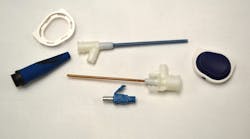
Knee implants for cadaver labs
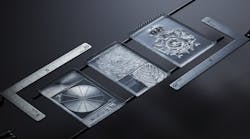
A medical manufacturer recognized a better way to make complex mold inserts after inspecting the detail and resolution possible from DMLS. “Other tooling applications for DMLS might include hardened steel tools and prototype die cast tooling, which has been generally ignored in North America,” says Greg Morris, Principal and COO of (Morris Technologies Inc), Cincinnati, Ohio,. “Demand, however, has us focusing on building smaller, highly complex parts from stainless and cobalt chromium alloys. They are by far the most widely requested due to their exceptional mechanical properties,” says Morris.
EGI Injection Mold
In a curious application, the company makes hip and knee implants for cadaver labs that are used to prove-out designs for the FDA. “Typically, these components are cast or machined out of bar stock,” says Morris. “On the horizon in the not-too-distant future is DMLS implants for live patients. DMLS allows for other possibilities, too. Next steps would be customizing implants to mate to surrounding bones and building structures conducive to bone growth, similar to Trabecular Metal.”
Another plus: DMLS lets engineers exploit inherent advantages of additive technologies. For example, layering lets engineers design in ways that traditional manufacturing methods might not allow. “Designing to the process is the real power of this technology.” Morris says. “We can build parts in DMLS that cannot be made any other way. Parts that might otherwise have been multi-part assemblies can be made as one piece. This cuts costs and boosts part quality and efficiency.”
A material for dental applications
EOS CobaltChrome SP1 is a superalloy powder well-suited for producing dental restorations such as crowns and bridges. Its composition corresponds to type 4 CoCr dental material in the EN ISO 16744 standard. “Skin & core,” a term used in the volume rate section below, means parts are run with fully dense surfaces and porous internal structures. A few properties include:
Conformal
Minimum layer thickness: 20 µm
Typical accuracy: Copings and bridges up to about four elements, ± 20 µm; bridges up to about eight elements (after subsequent stress relieving at 620 C for 1 hour), ± 20 µm
Minimum wall thickness: 0.012 in.
Surface roughness: As built, about Ra 8 µm, Rz 30 to 50 µm. After polishing, Rz to 1 µm
Volume rate (build speed): Full melting parameters (no skin & core, full density, maximum strength) 1.53 mm
Material composition (all values wt%)
| Co: 60 to 64 | Si: max. 1.6 |
| Cr: 25 to 30 | Mn: max. 1.5 |
| Mo: 5 to7 | Fe: max. 0.7 |
| W: 4 to 6 | C: max: 0.10 |
| Ce: 0.3 to 0.7 | Ni: max. 0.10 |
Relative density with standard parameters: Close to 100%
Density with standard parameters: 0.311 lb/in
Mechanical properties of parts at 20C:
Ultimate tensile strength as built:
1,350 MPa ± 100 Mpa. After stress relieving at 620 C for 1 hour — 1,400 MPa ± 100 Mpa
Yield strength (Rp 0.2 %) as built:
1,050 MPa ± 100 Mpa. After stress relieving at 620 C for 1 hour — 1,300 MPa ± 50 Mpa
Elongation at break, A5:
As built — 6 to 8%. After stress relieving at 620C for 1 hour — 3 to 4%
Young's Modulus:
As built — 170 GPa ± 20 Gpa. After stress relieving at 620C for 1 hour — 180 Gpa ±20 Gpa
Hardness HV10:
As built — 350 to 450 HV, after stress relieving at 620C for 1 hour — 350 to 450 HV
Thermal properties of parts, in as-built condition:
Coefficient of thermal expansion (25 to 500C) — 14.0 to 14.2 × 10
Want to use this article? Click here for options!
© 2010 Penton Media Inc.
Acceptable Use Policy blog comments powered by Disqus
advertisement
Webcasts
- 7 Critical Issues in Heater Selection for OEM Applications
Sponsored by: Minco - View Webcast Archive
advertisement