A guide to photoetching, and more
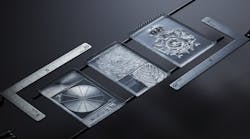
Photoetching (also called photo chemical etching or milling) allows for rapid design changes, low tooling costs, and fast turn-arounds in the manufacture of small, light-gauge metal parts. It delivers exact repeatability, making parts with intricate patterns, precise tolerances, and burr-free edges. Photoetching can even produce components that are impossible to duplicate by other production methods. The process suits small metal parts for implants and other medical devices because it easily produces prototype quantities as well as large production runs on tough corrosion-resistant alloys.
Photoetching, in detail
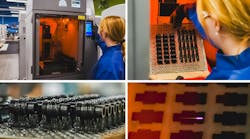
Photoetching involves coating a photosensitive, acid-resistant film on metal, exposing and developing a part image on the film, and then chemically etching the exposed metal away with an acid formulated for the metal. After the photo-resist film gets removed, parts undergo a final cleaning and are ready for inspection or subsequent added-value operations.
Photoetching uses photographic tooling plotted from common CAD files, so it eliminates expensive hard tooling usually associated with other metal manufacturing methods. Also, designers can specify more-intricate geometries and for a wider range of thin materials without worrying about burring and stress problems that typically arise with stamping or machining. Photetching also greatly shortens lead times. Design revisions are quickly and economically retooled during the prototype phase. Parts can be tooled and manufactured in a few days, instead of weeks or months.
Part applications and sizes
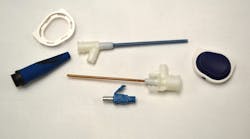
Applications cover a wide range of parts including needles, blade blanks, battery grids, electronics connectors, high-aspect-ratio collimators, and vascular stiffeners and closures. Parts can be made from metals as thin as 0.0005 in., and as thick as 0.100 in., or thicker when etching is combined with more-conventional methods such as machining or laser cutting.
Metals and specialty materials
Common metals that can be etched include silver, copper alloys, beryllium copper, stainless steels, aluminum, nickel alloys, spring steels, and other steel alloys. We focus on using difficult-to-manufacture specialty materials such as Elgiloy, molybdenum, Nitinol, niobium, titanium, tungsten, and Kapton. They have good mechanical characteristics for such parts as implants, springs, cathodes, blades, and stents. A brief guide should help in their selection:
Tungsten and molybdenum are difficult-to-etch refractory materials used for high-temperature, corrosion-resistant applications. Tungsten is commonly used for X-ray opaque markers in implantable devices.
Titanium is strong, light weight, highly resistant to corrosion, and has a strength comparable to 304 stainless steel. The metal is often used for implants, reconstructive meshes, and anode-cathode battery grids used in implantable devices.
Elgiloy comes in handy when requirements call for a material that is highly corrosion resistant with high fatigue strength. It is used for implants such as closures and vascular stiffeners.
Niobium is a lightweight refractive material with excellent high-temperature corrosion-resistance. It is ductile and easily formed.
Nitinol is a shape-memory alloy — that is, it returns to a predetermined shape after undergoing deformation. The material has excellent biocompatibility, good spring characteristics, and high corrosion resistance.
Polyimide is a film that exhibits good physical, chemical, and electrical properties over a wide temperature range. In fact, electrical and chemical-resistance properties are excellent even at unusually high temperatures. The material is used to make haptics for intraocular lenses and is well suited for foldable contact and acrylic lenses. Polyimide offers flexibility comparable to polypropylene and PMMA haptics, with greater tensile strength, and superior shape memory.
Added-value operations
Added-value operations include assembly, forming, plating, welding, lamination, heat treatment, electropolishing, and laser cutting or marking.
Electropolishing is useful in applications that need ultra-smooth edges or surface finishes. Metal removal is minimal, usually about 0.0002 to 0.0003 in. Electropolishing targets high-current-density areas such as sharp edges or peaks in surface grain-structure at a higher rate, which rounds the sharp edges and smooths or levels the surface areas. Surgical implants and devices intended for operating rooms benefit highly from electropolishing.
Forming goes hand-in-hand with certain etched parts. We combine photo etching, for blanking, with inexpensive or universal tooling, for forming. This combination allows proving designs in preproduction quantities without committing to expensive, progressive die tooling. Heat treatable copper and steel alloys can be used when formed material must have exceptional hardness or spring properties. In these cases, we etch and form parts in the soft state, then heat-treat them in inert-atmosphere furnaces for hardness and spring characteristics.
For bends that do not require structural strength and where a sharp internal radius is needed, such as board-level shielding applications, depth-etched bend lines or grooves are used for hand forming. This eliminates forming tools and thus lowers cost.
Plating is often added to etched parts to improve corrosion or wear resistance, electrical contact, or cosmetic appearance. Common deposits are gold, silver, tin, nickel, and palladium.
Want to use this article? Click here for options!
© 2008 Penton Media Inc.
advertisement
Webcasts
- Thermal Management: Heat Balance Control via IR Sensing
Sponsored by: Exergen - View Webcast Archive
Latest in Blogs
Leslie Gordon - "From Shop Floor to Software"
advertisement