Medical Silicon Conference Logo

No tape needed to hold this trachea tube

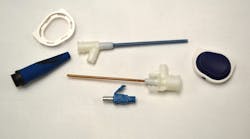
Close tolerances on the Phoneris Inner Cannulae required its parts fit with an existing tracheotomy component from another manufacturer.

Close tolerances on the Phoneris Inner Cannulae required its parts fit with an existing tracheotomy component from another manufacturer.

Patients with tracheotomies face possible complications from the inserted tracheotomy tubes. Dislodged tubes can cause respiratory problems, so nurses often tape them in place. “This common fix prompted us to look for ways to make tracheotomy tubes less stressful on patients and easy to connect and disconnect for caregivers,” says Brian Worley, CEO and founder of Lazarus Medical., Tulsa, Okla. The result is the Phoneris Inner Cannulae and Aeroflex, a two-piece device consisting of a ventilator connector and an inner cannulae. A lock on the end of the tube holds the Aeroflex in place, but easily disconnects when the apparatus needs suctioning.

Lazarus engineers turned to United Plastics Group Inc., Oak Brook, Ill (upgintl.com) for assistance with design, manufacturing, and assembly. UPG's contribution included engineering support from its Fremont, Calif. facility, and manufacturing to packaging at its ISO 9001/13485 plant in Tijuana. “They had to combine tooling design, design for manufacturability, quality and validation documentation, molding, PAD printing (2D pad to 3D surface), assembly, and final packaging for the Class II medical device,” says Lazarus VP David Seitelman.

Want to use this article? Click here for options!
© 2012 Penton Media Inc.


         Subscribe in NewsGator Online   Subscribe in Bloglines

Acceptable Use Policy
blog comments powered by Disqus

Back to Top

Social Media

Blog

Like us on

Follow us on

Browse Back Issues

May 2012

May 2012

April 2012

April 2012

June 2011

March 2012

Jan/Feb 2012

Jan/Feb 2012

December 2011

December 2011

November 2011

November 2011

Medical Edge Newsletters

View Sample Newsletters