Medical Silicon Conference Logo

Revolution in rehabilitation

Technology aids those with neurological disorders.

Like many her age, 20-year-old Ilana strives to stay fit. But hers is no ordinary fitness regimen. Ilana lives with cerebral palsy. And her program is Giant Steps, offered through Creative Children's Therapy. Developed in conjunction with Dr. Leonard Elbaum of the Department of Physical Therapy at Florida International University, the activity-based regimen is a six-week, five-day-per-week offering consisting of two-hour sessions. Since she was 4 months old, Ilana attended traditional therapy, but Giant Steps offers a new way to exercise and work toward becoming more independent. Prior to joining the program, Ilana mostly used a wheelchair and could take a few steps with a walker. Now she can walk 40 ft with a walker.

Giant Steps uniqueness and success is due to how new technology is being used in the neurorehabilitation setting.

This new technology is referred to as neurotechnology - a broad term used to encompass the applications of medical electronics that interact with the human nervous system. The foundation of neurotechnology is the electrical signals the body uses to send messages. Technology may be used to monitor electrical signals, block those signals, or use the electrical signals for functional gain. In the case of neurorehabilitation, technology is applied to provide healing or encourage natural restoration of an impaired body function. Robotics may be used for repetitive motion therapy, or suspension treadmill training systems may improve function of voluntary movement in the legs. The application of neurotechnology is revolutionizing the rehabilitation world and how therapy is delivered in the home. Back at the Giant Steps program, they are using functional electrical stimulation (FES) cycling, robotic treadmill gait training, and virtual reality exercises targeted toward children with cerebral palsy.

Evolution of external devices

Studies date back to the 1950s with clinicians applying electrical stimulation to patients with lower limb paralysis. The stimulation harnesses the motor nerves, which remain anatomically intact but are not functioning properly. Electrical stimulation devices use pulses of electricity to contract or excite the muscle, exploiting signal parameter such as pulse width, current, or voltage. The potential results are to minimize the loss of muscle bulk, improve muscle size and performance, and enhance physical fitness.

Transcutaneous neural stimulators like surface stimulation garments and external FES devices such as FES bikes or rowing machines deliver electrical currents to activate muscles for exercise. Today, electrical stimulation continues to be used but the field has expanded into neural re-education systems and neurorobotics.

The use of these systems is changing rehabilitation paradigms for treating individuals with neurological conditions such as traumatic brain injury, Parkinson's disease, stroke, spinal cord injury, and related disorders. The adoption of new technology in the rehabilitation environment has been mainly accepted for devices that include stimulation to the surface of the skin.

One fast-growing technology has been stimulation for drop foot syndrome. Common among stroke survivors and people with multiple sclerosis and spinal injury, the condition makes walking more difficult due to the inability to lift the foot while walking. In the past, this condition has been treated by using a plastic ankle-foot orthosis (AFO) and the person uses the hip muscles to lift the foot.

WalkAide drop-foot
stimulation system in use.
Photo: Innovative Neurotronics,
Inc, Austin, TX (Walkaide.com).

WalkAide drop-foot stimulation system in use. Photo: Innovative Neurotronics, Inc, Austin, TX (Walkaide.com).

A drop foot functional electrical stimulation (FES) system, the WalkAide by Innovative Neurotronics, Austin, TX, uses a patented tilt sensor technology for timely stimulation of the peroneal nerves via surface electrodes causing the foot to dorsiflex (movement that brings the top of the foot towards the lower leg) at the right time during the gait cycle. Proper fitting will allow for more natural, efficient, and safe walking pattern, with or without footwear.

This was the case for Bill Leasure of Clearwater, FL. Leasure had a spinal cord injury in 1974 as a result of an auto accident. After years of therapy, he was able to regain mobility but still had problems with some paralysis on his left side.

Fast forward 23 years, when Bill started to notice more back pain and he started tripping more frequently. “I went to see my orthopedic guy and he mentioned the drop foot stimulation system,” states Leasure. “But at the time it was too expensive for me to pay out of pocket so I ended up with an AFO.” After several months of working with the insurance company, he was approved for reimbursement of a drop foot stimulation system. It took about four weeks working with his therapist to get him properly fitted for the device and using it independently.

“I still use a cane, but now I trip much less often, feel more confident, and I can now wear sandals,” says Leasure. He is more mobile using the device; volunteering at the Clearwater Marine Aquarium and working with fellow disabled veterans. This stimulation system is one example of how technology has migrated from the laboratory to the clinic and into the home.

Advances in implantable electrodes are
drawing on new biomaterials. Shown
here is a soft, bioactive conductive
polymer electrode. Photo: Biotectix,
LLC, University of Michigan, and Allied
Minds (alliedminds.com).

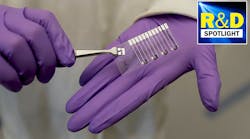
Advances in implantable electrodes are drawing on new biomaterials. Shown here is a soft, bioactive conductive polymer electrode. Photo: Biotectix, LLC, University of Michigan, and Allied Minds (alliedminds.com).

Engineering supports advances

According to market research firm Neurotech Reports, San Francisco, (neurotechreports.com), the market for neurorehabilitation systems will grow, from $348 million in 2010 to $757 million in 2014. New and emerging product categories in this segment include cortical stimulation systems for treating stroke-related disorders, neural re-education systems, and neurorobotic systems. Much of the technological development and enhancement of devices originates from engineering advances in electrode design, materials, coatings, and stimulation parameters. These advancements support these technologies in the clinical environment and the migration of technologies into patients' homes.

In the case of homebound therapies, small neuromuscular electrical stimulators the size of a PDA can be used to exercise targeted muscles. FES bikes are more compact and use Bluetooth technology to allow clinicians to monitor their patients. Systems to rehabilitate arms and shoulder muscles use surface stimulation and electromyographic (EMG) signals. The migration of the device to patients' homes is largely due to simplicity in the design, reduction in cost, patient acceptance of technology, and the slow but possible reimbursement by the health insurance companies, which has become a major obstacle for neurotechnology industry expansion.

New technology is not without its challenges. Reimbursement is such an issue for this industry that many organizations have their own departments to work directly with health insurance companies. Insurance reimbursement drives the availability of technology to the rehabilitation environment. It is not only the reimbursement for the technology, but the medical services that are wrapped around the proper delivery of the device to the patient in the form of physical therapy or customized fittings. Understanding medical coding is critical in this industry and is a consideration early in the development and design of devices. A second challenge is the regulatory environment. The consumer technology world is more relaxed than its medical technology cousin. Long-term clinical trials, significant sample sizes, and review delays drive up the cost of devices. This also extends the timeline from laboratory to bedside. Finally, awareness is also a challenge for this young industry. Cutting through the mass marketing efforts of the pharmaceutical industry leaves the stigma of the “last resort syndrome.” Consumers commonly adopt invasive technology only after they have tried all other available options. Rehabilitation institutions are strained to adopt and train staff to administer new technology.

Much more to come

Research continues to drive the advancements of neurotechnology. Two particular areas are the role of cortical plasticity and the evolution of implantable electrodes. Understanding cortical plasticity as a rehabilitation tool of the human body is shaping new device design in which electrical energy to the brain seeks to effect transformations in the representation of sensory and motor functions in the cerebral cortex. Studies at the Rehabilitation Institute of Chicago are currently using small electrodes over the motor cortex of stroke survivors with hemiparesis to aid in therapy. Others at the Wadsworth Center in New York are using transcranial magnetic stimulation on persons with spinal cord injury to reduce movement problems by guiding the nervous system's natural ability to adapt neural pathways for muscle response or brain-wave training.

Advances in implantable electrodes are drawing on new biomaterials. Several new polymeric biomaterials are promising to enhance the functionality of existing neural interfaces, which are currently based on metals. At least two commercial firms have begun offering electrodes and other components of neural stimulation and recording systems that have mechanical, electrical, and functional properties not found in metal electrodes.

One of the most promising commercial ventures in this area is Biotectix LLC, a Quincy, MA, startup that spun off from research at the University of Michigan last year. David Martin, a University of Michigan researcher who has been working with new electrode materials for some time, is one of the founders of the startup, along with two of his doctoral students.

Traditional metallic electrodes (steel, platinum, iridium, and gold) are energy inefficient, hard, non-biocompatible, and can cause local tissue damage and scarring. They also have limited-MRI compatibility, and often don't function for as long or as well as intended, leading to more frequent battery replacement. Devices that fall into this class include pacemakers, cortical probes, cochlear implants, glucose sensors, and deep brain stimulators.

Biotectix has developed soft, bioactive conductive polymer electrodes and coatings for electrodes. This novel technology results in increased electrode sensitivity and charge transfer capacity conferred by polymer coatings, significantly enhancing device function and battery life. In addition, drugs can be released from the polymer coating as desired: passive, intermittent, or extended release.

These advances are years away from entering the traditional rehabilitation environment. How they emerge into the health care system is still an open question. As with external neurotechnology, programs such as Giant Steps are wrapped around the technology for delivery into the rehabilitation environment and acceptance by a more technically savvy consumer.

Want to use this article? Click here for options!
© 2010 Penton Media Inc.


         Subscribe in NewsGator Online   Subscribe in Bloglines

Acceptable Use Policy
blog comments powered by Disqus

Back to Top

Browse Back Issues

July/August 2010

July/August 2010

June 2010

June 2010

May 2010

May 2010

April 2010

April 2010

March 2010

March 2010

January 2010

Jan./Feb. 2010

December 2009

December 2009

Medical Edge Newsletters

View Sample Newsletters