Medical Edge E-Newsletter

FEA builds better MEMS


         Subscribe in NewsGator Online   Subscribe in Bloglines

Manufacturing MEMS

Today, it takes more than just on-the-floor manufacturing know-how to help ensure realistic and cost-effective designs. Finite-element analysis software — long the province of researchers as well as aerospace and automotive OEMs — is increasingly used by more manufacturers to test components in the digital world and iron-out flaws early in development — sometimes even before physical prototypes are built.

The examples here include a micro-electo mechanical system that shows how Comsol Multiphysics FEA software from Comsol Inc. in Burlington, Mass., (comsol.com) helps build virtual prototypes of a micromixer for a lab-on-a-chip. The design is then made with standard microfabrication techniques and simple soft lithography, a new method that fabricates nanostructures using molds, elastomeric stamps, or conformal photo-masks. A second example uses the software to help prototype a bio “cage” for diabetes treatment.

Simulating a micromixer

Miniature analysis systems, or labs-on-a-chip, work in little time and need only small quantities of samples and reagents to deliver high-resolution results. Such devices typically include detectors, micropumps, reaction chambers, and micromixers. One downside of such systems is that sample flows are typically laminar, so diffusion hinders reaction rates, analyte accumulation times, and detection sensitivities.

Many biological processes — such as DNA hybridization, cell activation, enzyme reactions, and protein synthesis — require rapid reactions and efficient mixing of reagents. But for diffusion-based devices, mixing can take relatively long periods — tens of seconds, or even minutes. This is particularly true when solutions contain macromolecules, such as DNA and proteins, or large particles such as bacteria and blood cells.

A new kind of micro-scale mixing device based on ferrohydrodynamic actuation speeds the mass transport of fluids. The device manipulates ferrofluid streams (stable water suspensions of magnetic particles which can be made biocompatible) with local alternating magnetic fields. This rapid mixing overcomes diffusion barriers.

Comsol Multiphysics software simulations provide virtual prototypes of the mixing device by incorporating different physical domains including time-domain electromagnetics, fluid dynamics, convective diffusion, and custom partial differential equations. Once the optimal device geometries and operating conditions are determined from simulations, physical prototypes are made with standard microfabrication and simple soft lithography techniques that allow rapid testing with microfluidic channels. The combination of virtual and physical prototyping provides significant cost and time reductions.

Ferrohydrodynamic actuation requires continuously rotating the magnetic moment of nanoparticles within a ferrofluid through externally applied magnetic fields. The software helped us study the conditions under which localized vortices form within a ferrofluid under the influence of a traveling-wave magnetic field. We started with the magnetic relaxation equation for a ferrofluid and coupled it to incompressible Navier-Stokes equations for fluid flow.

We also introduced the electromagnetic domain into the simulation and computed the magnetic force and torque acting on the ferrofluid due to externally applied fields. These force and torque terms drive the fluid flow and under appropriate conditions create localized vortices that efficiently mix the contents of the ferrofluid. Finally, we put convective diffusion equations into the simulation to quantify the effectiveness of the ferrohydrodynamic mixing.

Copper electrodes under the microfluidic channel generate the traveling magnetic field that drives ferrohydrodynamic actuation. Because of symmetry, there is no Z-axis component of the magnetic field. To study mixing effectiveness under worst-case conditions, an initial concentration step profile (0% concentration on one side, and 100% on the other) is imposed on the simulated device geometry.

Simulation results show that the mixer's efficiency is directly related to localized ferrohydrodynamic flow velocity. To determine the best excitation frequency for mixing, we first examined flow profiles inside the microchannels at different frequencies. Lower frequencies produce faster flows. Unlike electrokinetic mixers, the ferrohydrodynamic micromixer is insensitive to fluid properties such as density, viscosity, conductivity, and dielectric constant. Better yet, the fluids sufficiently mix in relatively short microfluidic channel segments, and can be scaled to nano and macro channels.

FEM modeling helps build possible diabetes cure

By: Nicola Bocca, Camillo Ricordi, Norma S. Kenyon, Paul Latta, Peter Buchwald

Diabetes Research Institute, Univ. of Miami

Leonard M. Miller School of Medicine, Miami, Fla.

A promising approach to treat diabetes involves transplanting Langerhans islets — groups of hormone-producing cells in the pancreas — into tiny subcutaneous “cages.” The devices mechanically protect islets while letting nutrients flow in and out. Because the cells are restricted to the device, localized immunosuppression might provide sufficient protection against rejection. (Dr. Camillo Ricordi at the Diabetes Research Institute in Miami pioneered this idea.)

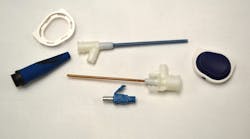
A prototype cage being tested in small rodents consists of a cylindrical, metal mesh chamber with a multihole tube “sprinkler” running along its axis. The sprinkler is intended to deliver drugs through continuous infusion from a pump. The device is implanted 40 days before islets are transplanted to let tissue and vessels develop around it. During this period, the chamber is filled with a soft plug to keep it free from invading tissue.

A drawback of catheters with a lot of exit holes is that fluid tends to exit through holes nearest the infusion connection, especially at low flow rates and pressures. Other catheter designs have been suggested, including the obvious one of increasing hole size with distance. We used this idea in the sprinkler. Comsol multiphysics simulations helped us evaluate drug distributions for different hole configurations and estimate best doses and inflow rates to provide a large therapeutic range.

The cage's model consisted of a cylindrical chamber with liquid inflow along the central sprinkler and outflow along tissue-embedded walls. For fluid dynamics, we used the incompressible Navier-Stokes model for Newtonian flow. We used a generic diffusion equation to describe convective and diffusive fluxes. To simplify the model, we assumed no active drug transport due to blood flow within the chamber.

The simulation geometry consisted of the fluid part of the device. One subdomain was the internal volume of the cylindrical sprinkler. A second subdomain was the remaining internal volume of the cylindrical chamber, including the area of holes through the sprinkler walls. The original design had five uniform-sized hole pairs successively rotated 45° around the main axis and at a distance from each other. The new design increased the area of the more-distant holes (the last two pairs of holes had to be changed to an ellipsoid shape to fit them on the sprinkler).

Boundary settings in the multiphysics 3D model included the exterior surface of the chamber, top and bottom capped ends, sprinkler surface, and holes. A default setting in the software generated meshes of up to 32,000 tetrahedral elements. The model was solved first as a time-dependent problem up to six hours, and then as a stationary problem using the previous solution as starting point. Computations came from the Pardiso direct solver on a Dell Precision PC with a 3.2 GHz CPU running Linux.

Simulations showed the largest drop in velocity takes place at the first, closest hole in the uniform-hole design. Drops in velocity were more uniform in the new design. A real-world experiment using blue dye pumped through a three-hole sprinkler submerged in water confirmed results.


Commenting terms of use blog comments powered by Disqus

Want to use this article? Click here for options!
© 2008 Penton Media Inc.

Back to Top

Webcasts

Browse Back Issues

November 2008

November 2008

October 2008

October 2008

September 2008

September 2008

July 2008

July 2008

June 2008

June 2008

May 2008

May 2008

April 2008

April 2008

Medical Edge Newsletters

View Sample Newsletters


design engineering jobzone promo

Medical Design Careers