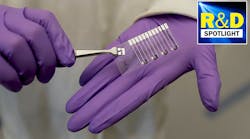
Student designers show off a low-cost prosthetic hand
Although medical prosthesis are expensive, device designers in developed nations can afford not to scrimp because government subsidies pay much of the bill. Designers in developing countries, however, usually do not have access to deep pockets. Therefore, they must find cost-effective ways to meet prosthetic challenges.
An example is the Myoelectric Hand Prosthesis (MHP) that comes from a team of engineering students at the ITESO graduate school, Universidad Jesuita de Guadalajara in Mexico. The prosthesis is for and amputees in regions where affordable and advanced healthcare products and services are rare.
The myoelectric prosthesis design is based on the idea that electrical signals produced by contracting arm muscles can control the hand. The MHP has four different user-controller movements: open, close, wrist right, and wrist left. Also, the system can regulate the closing pressure to generate more than 100kPa, enough to lift and hold many common objects.
The electronic brain of the MHP is Freescale's MC9S08QE4 microcontroller (MCU), cost-effective, general-purpose, and low-power device. Its small package and many features fit the application. Power for the MHP actuators is driven by the Freescale MC33887 H-bridge (an H-shaped circuit diagram) device.
The MHP senses signals through electrodes in the user's forearm. These signals are in the mV range so they are amplified by a gain of 1,064.
To eliminate nonmyoelectric signals, the team designed a second-order low-pass filter and a first-order high-pass filter for a 15 to 400 Hz range as the next myoelectric (muscle) signals step. In addition, a referenced voltage comparator selects a level that eliminates noise signals from other muscles in the user's forearm. Lastly, circuitry drives the correct voltage to the microcontroller's keyboard interrupt pins.
The MCU initializes from reset, so the system checks the reset sources, such as power on, low battery voltage, illegal op code, and watchdog (reset mechanism in case of software execution failure).
After initializing the 8-bit CPU and peripherals, the MCU enters a low power mode. Only an external interrupt, such as a change in the forearm's myoelectric signals, may wake the system. Then the system enters a ‘capturing signals’ state. This turns off the external interrupts and enables the modulo timer interrupt, the microcontroller's internal mechanism for counting time.
Then the microcontroller enters low-power mode. The system may wake up from this low-power mode with a timer interrupt. The interrupt has to be at least two times faster than the higher myoelectric signal frequency to prevent important data from being lost.
Our tests registered 3.125 KHz as the higher frequency. Therefore, the interrupt is configured for every 151.5 ms (6.6 kHz). In the interrupt routine, the myoelectric input signals are checked and their state is registered. Then the controls check an assigned counter. If a configurable count has not arrived, the MCU enters a low-power mode until another timer interrupt arrives. But if the count has been reached, the MCU enters into a lower-power decoding signals state.
In the decoding signal state, the MC9S08QE4 checks which myoelectric signal registered more activation in the time frame and decides which state comes next: opening or closing the hand, or turning the wrist left or right. If the system decodes that the MCU woke up from low-power mode because of a glitch, the system does nothing but allows external interrupts and returns to the low-power mode.
Once the system decides which state comes next, the timer and pulse-width modulator configures output signals to generate a movement in the prosthesis. Then the system looks for external interrupts and enters the low-power mode to wait for myoelectric stimulation.
The analog-to-digital converter is constantly checking the current consumed by the dc motors to control the pressure produced by the closing hand movement. This monitoring is possible because of the dedicated hardware provided by the H-bridge device, which gains feedback from the power driven to the motors.
The processor has 4k bytes of flash memory for code and 256 bytes of RAM for data. The MHP uses 983 bytes of code and 35 bytes of data. This leaves about 3k bytes of flash memory and 221 bytes of RAM for upgrades and preloaded movement routines.
Future versions of the hand will feature lighter and tougher materials for the mechanical hardware, resulting in a more productive and better looking prosthe
Freescale also provides future design modifications. The pin-to-pin compatibility in the older and widely used Flexis microcontroller family lets designers migrate applications between 8-bit and 32-bit MCUs to improve performance and add more features to products.
Want to use this article? Click here for options!
© 2012 Penton Media Inc.
Acceptable Use Policy blog comments powered by Disqus
Webcasts
- How to Quantifiably Confirm Cure of Light Cure Adhesives
Sponsored by: Henkel - View Webcast Archive
advertisement