Medical Edge E-Newsletter

FEM modeling helps build possible diabetes cure


         Subscribe in NewsGator Online   Subscribe in Bloglines

A promising approach to treat diabetes involves transplanting Langerhans islets — groups of hormone-producing cells in the pancreas — into tiny subcutaneous “cages.” The devices mechanically protect islets while letting nutrients flow in and out. Because the cells are restricted to the device, localized immunosuppression might provide sufficient protection against rejection. (Dr. Camillo Ricordi at the Diabetes Research Institute in Miami pioneered this idea.)

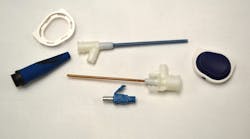
A prototype cage being tested in small rodents consists of a cylindrical, metal mesh chamber with a multihole tube “sprinkler” running along its axis. The sprinkler is intended to deliver drugs through continuous infusion from a pump. The device is implanted 40 days before islets are transplanted to let tissue and vessels develop around it. During this period, the chamber is filled with a soft plug to keep it free from invading tissue.

A drawback of catheters with a lot of exit holes is that fluid tends to exit through holes nearest the infusion connection, especially at low flow rates and pressures. Other catheter designs have been suggested, including the obvious one of increasing hole size with distance. We used this idea in the sprinkler. Comsol multiphysics simulations helped us evaluate drug distributions for different hole configurations and estimate best doses and inflow rates to provide a large therapeutic range.

The cage's model consisted of a cylindrical chamber with liquid inflow along the central sprinkler and outflow along tissue-embedded walls. For fluid dynamics, we used the incompressible Navier-Stokes model for Newtonian flow. We used a generic diffusion equation to describe convective and diffusive fluxes. To simplify the model, we assumed no active drug transport due to blood flow within the chamber.

The simulation geometry consisted of the fluid part of the device. One subdomain was the internal volume of the cylindrical sprinkler. A second subdomain was the remaining internal volume of the cylindrical chamber, including the area of holes through the sprinkler walls. The original design had five uniform-sized hole pairs successively rotated 45° around the main axis and at a distance from each other. The new design increased the area of the more-distant holes (the last two pairs of holes had to be changed to an ellipsoid shape to fit them on the sprinkler).

Boundary settings in the multiphysics 3D model included the exterior surface of the chamber, top and bottom capped ends, sprinkler surface, and holes. A default setting in the software generated meshes of up to 32,000 tetrahedral elements. The model was solved first as a time-dependent problem up to six hours, and then as a stationary problem using the previous solution as starting point. Computations came from the Pardiso direct solver on a Dell Precision PC with a 3.2 GHz CPU running Linux.

Simulations showed the largest drop in velocity takes place at the first, closest hole in the uniform-hole design. Drops in velocity were more uniform in the new design. A real-world experiment using blue dye pumped through a three-hole sprinkler submerged in water confirmed results.


Acceptable Use Policy
blog comments powered by Disqus

Want to use this article? Click here for options!
© 2009 Penton Media Inc.

Back to Top

Browse Back Issues

December 2008

December 2008

November 2008

November 2008

October 2008

October 2008

September 2008

September 2008

July 2008

July 2008

June 2008

June 2008

May 2008

May 2008

Medical Edge Newsletters

View Sample Newsletters


design engineering jobzone promo

Medical Design Careers