Nail guns could fix broken bones
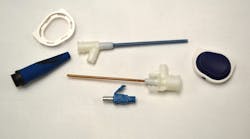
In the same way a carpenter shoots nails into wood, surgeons might shoot biocompatible nails into fractured bones to hold the pieces together. Gary Farley at the U.S. Army Research Lab at Langley Research Center says biocompatible-composite nails or rods would eventually be absorbed by the body. Metal plates and screws used on people who are still growing must be removed in a second surgery.
Farley proposes using many small fasteners to transfer loads across a joint rather than using a few larger ones as is the current practice. Several smaller fasteners would be more reliable than fewer large ones.
When compared to traditional procedures for treating compound fractures, the proposed method involves less surgery, poses a lower infection risk, transfers load more efficiently across fractures, and thereby promotes better healing while reducing the need for casts.
Farley adds that the nails or rods could be shot into place using a small pneumatic gun about the size of a ball-point-pen and driven by pressurized carbon dioxide. Bone glue applied to fractures before inserting the rods would further stabilize bone segments.
Researchers at Duke University have begun testing encapsulated chemotherapy drugs using a thermal system that provides precision heat therapy in women whose breast cancers have spread to their chest wall. BSD Medical Corp., Salt Lake City, (bsdmc.com) manufactures equipment that provides the heat as focused radio frequency and microwave energy. The treatment uses a chemotherapy drug packed into tiny heat-sensitive capsules. When the capsules are delivered by blood flow to a tumor, it is heated, causing the capsule to release the chemotherapy without subjecting the rest of the body to the drug's toxicity. Duke University's Mark Dewhirst says heat boosts the killing power of radiation and chemotherapy by a factor of 10.
What's more, heat therapy makes tumor blood vessels porous so capsules can pass more easily into the tumor. That lets the method deliver 30 times more drug than would normally reach the tumor. In addition, heat increases a tumor's oxygen levels, critical to the proper functioning of many chemotherapy agents.
Acceptable Use Policy blog comments powered by Disqus
Want to use this article? Click here for options!
© 2009 Penton Media Inc.
advertisement
Webcasts
- Antimicrobial Developments in
Silicone Rubber for the Medical Industry
Sponsored by: Wacker Silicones - View Webcast Archive
advertisement