Research & Development
Nebulizing technology to wage war against HAIs
An advanced disinfection system for eradicating viruses and bacteria in hospital rooms, which often result in HAIs from “superbugs” such as MRSA and C diff, delivers a dense cloud of sub-micron disinfectant droplets, resulting in a dry fog that leaves behind no residue or toxic byproducts. And in laboratory tests, the system has demonstrated 100% kill rates of viruses and bacteria. ...
R&D Notebook-The America Invents Act and how it affects medtech
After six years of lobbying, arm-wrestling, horse-trading and debate the most comprehensive reforms and changes to US patent system in over 60 years is now law. This is The Leahy (D-VT) Smith (R-TX) “America Invents Act” or “AIA.”...
Study of US-developed cartilage repair treatment to commence in Taiwan
Medical Metrics, Inc (MMI), a provider of medical imaging core lab services for global clinical trials, has been selected by Exactech, Inc, to conduct an independent evaluation of medical images from the BiPhasic Cartilage Repair Implant (BiCRI) IDE Clinical Trial approved by the Taiwan FDA. ...
BRIC heart valve markets to grow 7%-plus through 2016; challenges ahead
The heart valve markets in Brazil, Russia, India and China (BRIC) are expected to experience annual growth of more than 7% through 2016 while presenting specific challenges to large multinationals seeking to gain market share. This according to research announced by the Millennium Research Group....
Means for measuring surgical strain should shape device designs
Researchers have developed a new method to measure the physical strain placed on surgeons while performing minimally invasive surgery. By analyzing surgeons’ motions in the operating room, researchers will gain new insights into proper postures, techniques, and body angles that should influence the development of new ergonomically designed minimally invasive surgical instruments. ...
Collaboration to yield novel transcatheter heart valves
DSM, a biomedical materials producer, and the University Medical Center Utrecht academic hospital, announced a collaboration agreement. DSM will contribute its Dyneema Purity fiber technology to enable UMC Utrecht to develop and evaluate a prototype of a non-biological supportive scaffold for the minimally invasive treatment of valvular and vascular diseases. ...
Nanotechnology converts body heat into power; could be used to track patients’ needs
A thermoelectric device that converts body heat into an electrical current could soon make a medical difference. Developed by researchers in the Center for Nanotechnology and Molecular Materials at Wake Forest University, the Power Felt device is comprised of tiny carbon nanotubes locked up in flexible plastic fibers and made to feel like fabric. The technology uses temperature differences–room temperature versus body temperature, for instance – to create a charge. ...
NSF supports bioabsorbable biomedical implants
The National Science Foundation (NSF) is funding research work on bioabsorbable biomedical implants for orthopaedic applications. ...
Poll: More readers expect increases in R&D spending in 2012 than two years ago
Medical Design readers are upbeat about 2012 when it comes to R&D spending....
Editorial: Ford drives development of 'health-caring' cars
Glucose monitors with voice feedback for diabetics. Heart-monitoring seats for patients with hypertension. And voice-controlled access to location-specific pollen counts for those living with asthma and allergies. If Ford and its partners have their way, there may be a "health-caring" car in your future with these features, and that's likely to be just the beginning. ...
Battelle report and MedicalDesign.com poll show more R&D spending in 2012
R&D spending in US is projected to rise according to Battelle and MedicalDesign.com....
R&D Notebook: When it comes to sterilization, matching methods with materials is paramount
Sterilization methods for medical devices must be sufficiently aggressive to kill bacteria, fungus, spores, and viruses. But which method works best for the myriad of plastics and materials available to designers? Read on....
Grant awarded to develop biodegradable implants
The National Science Foundation awarded a $175,000 grant for research aimed at developing biodegradable medical implant materials that would promote tissue regeneration and disappear after serving their functions in the body....
Collegiate competition showcases medical inventions
Invent Now, a nonprofit organization that recognizes and encourages invention, announced the first prize winners of its annual
Talking supercomputers could play pivotal role in medtech
IBM Watson supercomputer could prove to be important physician’s tool....
Q&A: Designing the future
What’s ahead for medical device design? Read on as members of the design, research, and regulatory teams at Providence, RI-based Ximedica (www.ximedica.com),analyze medical device design of the future, from 2012 and beyond. Discussing their thoughts with Research and Product Strategist Hope Hopkins (as moderator) are Chief Innovation Officer and Co-Founder Aidan Petrie; Research and Product Strategy Principal Jessica Willing-Pics; and Clinical & Regulatory Affairs Senior Vice President Tom Varricchione. ...
Changing demographic changes medtech designs
With age comes the need for practical application of human factors and usability in medtech products for doctor and patient alike....
Technology enables researchers to predict how orthopedic implants will perform
An advanced joint simulation technology by Advanced Mechanical Technology, Inc (AMTI), Watertown, MA, is showing researchers how new prosthetic designs will perform inside the human body. ...
Biologic components start-up starts
Biologic Therapies, an Ocala, FL-based start-up, is specializing in the design and manufacturing of components for the biologics sector of the medical device industry....
More portability and plastics in 2012
A webinar held last week revealed a few insights into what medical device designers are thinking when it comes to design and material trends. ...
Smart technology now runs skin deep
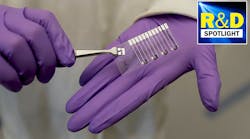
An ultra-thin skin-like patch that mounts directly onto the skin like a temporary tattoo combines electronic components for sensing, medical diagnostics, communications, and human-machine interfaces. The skin-mounted electronic innovation was developed by a team of researchers led by John A. Rogers, professor of engineering at the University of Illinois in collaboration with Northwestern University engineering professor Yonggang Huang....
R&D Notebook: Knowing elements of style
This is the second of a two-part series. Part one appeared in the October issue (page 43) and discussed Rules 1-3. This second part begins with Rule #4....
Advanced materials advance laser surgery
Safe removal of dangerous tumor now possible with handheld laser scalpels engineered with "omnidirectional" light capabilities....
Dutch consortium more than 'skin deep'
In order to stimulate innovation and employment, the Dutch central and provincial governments are investing in Skin Comfort, a project driven by a consortium consisting of Radboud University Nijmegen Medical Centre (RUNMC), Philips (healthcare as well as consumer products such as personal care devices), TenCate (artificial turf systems), and eight others. ...
Industry Viewpoint: Study shows users of combination devices respond to good design
Study by Cambridge Consultants, in conjunction with MassMEDIC, was conducted to determine the patient-related drivers for drug-delivery combination products....