Parkinson’s research results in new treatments
Electronic and drug therapies advance; exercise receives serious consideration.
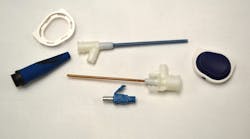
Deep brain stimulators use three major components. The neurostimulator contains a battery and electronics and is implanted subcutaneously in the chest. The extension is a thin, insulated wire connecting the stimulator to the DBS lead. The lead has four electrodes at its tip and is implanted in the brain; jigs are used to help with placement. Some of the newest stimulators are rechargeable, eliminating the need for surgical replacement of the device.
Photo courtesy of Medtronic, Inc.
Many people think of Parkinson’s disease (PD) merely as uncontrolled shaking or tremors. Yet, virtually all people with PD suffer from a wide variety of afflictions and symptoms, including bradykinesia (slow body movements), dyskinesia (uncontrolled body movements, e.g. flailing), impaired speech, dizziness, loss of the sense of smell, urinary incontinence, constipation, and muscle stiffness. Many times shuffling replaces normal gait and posture becomes stooped-over. Add to this impaired sleep and depression; with the depression caused by the low dopamine levels, not by the cognitive awareness of the other symptoms. Eventually, most people with PD simply grind to a halt, unable to move. Swallowing becomes difficult, drastically increasing the incidence of aspiration pneumonia. Dr. James Parkinson, for whom the disease is named, called it “the saddest of diseases.”
Some of these symptoms mimic those of other diseases, for example multiple sclerosis (MS) and essential tremor. Essential tremor is a tremor in the arms, head or voice during voluntary movement. Currently, PD diagnosis is currently made through symptom observation. One carefully observed characteristic is the patients’ handwriting. When suffering from PD, a person’s handwriting becomes progressive smaller. The height of each letter diminishes until it dissolves into an illegible series of bumps or scribbles.
Another area of acute interest, with regard to PD diagnosis, is sleep abnormalities. A precursor to PD is REM sleep behavior disorder (RBD). One study showed that 38% of patients with RBD eventually developed PD. People with PD often experience vivid and detailed dreams, and it is not uncommon for them to attack their bed partners. By performing sleep studies, doctors are gaining insight into the RBD of Parkinson’s patients. About 38% of patients with RBD eventually develop PD.
Early PD diagnosis is important because there is evidence that progression might be slowed though not reversed.
Delivering and pedaling treatments
The causes of Parkinson’s are unknown (see sidebar), but in most cases Parkinson’s disease becomes apparent when the brains’ dopamine producing cells die off. Dopamine is a neurotransmitter that affects behavior, cognition, voluntary movement, motivation and reward, and sleep. Dopamine has another role too: as precursor to norepinephrine. Norepinephrine plays a dual role as both a drug and hormone affecting heart rate, glucose release, and blood pressure. PD symptoms are difficult to treat because dopamine can not cross the blood-brain barrier (BBB). The BBB also prevents dopamine from getting from cerebrospinal fluid into the blood stream, stymieing efforts to measure its concentration.
While the BBB is not a visible membrane it does separate circulatory blood and cerebrospinal fluid with a layer of epithelial cells, supported by astrocytes— star-like cells. Small hydrophobic molecules pass it, as does glucose, which is actively transported across it, but hydrophilic molecules and most bacteria are stopped. Hence, though dopamine is readily synthesized, it is undeliverable in its present form, i.e., as a pure drug.
Until recently, natural diffusion was used to get the liposomes across the BBB. But researchers have developed a different method, called convectionenhanced delivery (CED). With CED a specially designed catheter is inserted into the brain. The catheters’ cannula design minimizes infusate reflux along the cannulas’ outer circumference by using steps. Reflux is the backflow of infusate up the cannulas’ outside rather into brain tissue. Metal cannulas have given way to ones made of silica.
The infusate is pumped into the spaces between the brain cells. Maximum infusion rate is about 5 μl/min; above this rate, reflux is again present. Distribution of the pressurized infusate is greatly enhanced by the body’s natural pulsation of blood vessels, resulting in an even concentration over a large area. Two methods are used to help ensure proper cannula placement. One is a guide glued to the skull with dental acrylic. The second is part of the CED infusate itself. The infusate contains Gadoteridol-loaded liposomes. Gadoteridol is an MRI contrast media. Cannula design and liposome delivery have profound implications not only for PD treatment but also for MS, Alzheimer’s, and various brain cancers.
Continue to next page.
Want to use this article? Click here for options!
© 2012 Penton Media Inc.
Acceptable Use Policy blog comments powered by Disqus
Webcasts
- How to Quantifiably Confirm Cure of Light Cure Adhesives
Sponsored by: Henkel - View Webcast Archive
advertisement