Medical Edge E-Newsletter

Simulating Stresses In Stents, Tension In Tissue


         Subscribe in NewsGator Online   Subscribe in Bloglines

Two natural phenomena hamper the use of FEA (finite-element analysis) and CFD (computational fluid dynamics) when it comes to physiological tasks: biologic shapes with nary a straight line are difficult to model by conventional methods, and material properties of organs and tissue vary from person to person. By comparison, analyzing stresses in metal structures is a breeze because parts have relatively similar shapes and material properties are well known.

But researchers are slowly chipping away at the biological problems. For instance, MRIs and CT scans can capture organic details in body parts while more recent software developments can mesh bones and organs with uniform and repeatable element shapes.

Of course, the traditional applications of FEA are still good. “It's useful, for instance, minimizing the number of physical laboratory tests a product might need,” says Brent Saba, owner and principal engineer of SMPES LLC, Baton Rouge, La., (smpes.com). “If a new design improves on an old one, FEA results can be documented and show that physical lab testing of the new device is not necessary.”

Mimic this

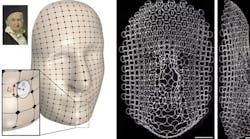
Running FEA simulations means first meshing a model, even if it's an odd-shaped aneurysm. Software developers at Materialise Inc, Leuven, Belgium (materialise.com) have developed a preprocessor for FEA and CFD called Mimics that takes MRI or CT scans and helps users construct accurate models of body parts, organs, and abnormalities such as aneurysms.

“Depending on the MRI's scan resolution, you can start with 20 to several hundred slices,” says Materialise application engineer Michael Lawrenchuk. “Then you identify the elements of the organ or vessel you want to model and isolate that structure using the software's segmentation tools. After isolating the surface model, users apply a triangle surface mesh to it. “FEA meshers are picky as to what kind of files they accept, and they have a triangle-quality limit. Equilateral triangles are considered ideal so the remesher works on getting every element triangle as close to that as possible.”

The model with the surface mesh is imported into an FEA package which turns the surface into a volume model. “You can then bring that back into Mimics to assign material properties. The software calculates a Hounsfield unit for each element, a way to measure density from medical images and provides a gauge of tissue strength. If the model is a bone, overlaying the volume mesh on the original model lets users assign material properties to its spongy and compact layers, making the simulation more precise,” he says.

Scanning and modeling blood vessels is a bit more work than nonmoving bone because patients must first drink a contrast agent, such as barium. It makes blood show up clearly in images. Most CFD software has fluid models for blood. “But if the software doesn't, you can make your own model by applying parameters such as density and viscosity,” says Lawrenchuk.

See how it flows

Fluid flows are slightly more complex than stress analysis because of fluid-structure interactions — blood moving against elastic vessels. Thanks to a partnership between visualization-and-engineering company Computational Engineering International, Apex, N.C., (ensight.com) and the Department of Diagnostic Radiology at the University of Freiburg, Germany, the medical imaging community may soon be working with new visualization techniques. These would make it possible to use CEI's EnSight software for better blood flow visualization and analysis with conventional Dicom (Digital imaging and communications in medical) data, a format used in most hospitals.

The partnership will focus on flow-sensitive 4D (x, y, z, and time) MRI techniques, developed by Michael Markl at the University of Freiburg. Markl and colleagues have used the techniques to measure blood flows in common vascular diseases such as aneurysms, with the goal of improving future diagnoses and better understanding the formation and progression of these conditions. The visualization techniques take advantage of 3D spatial encoding and flow-sensitive MRI to provide anatomical and 3D velocity information through a complete heart beat.

Building a better back

When manufacturer of surgical spinal products Spinal USA, Flowood, Miss., (spinalusa.com) designed a new series of vertebral body replacement (VBR) implants, the company had to meet FDA requirements for physical laboratory testing to get approval for use. Surgeons insert VBRs between vertebrae along with bone-growth material which eventually grows or fuses the two vertebrae together and replaces damage discs.

“Prototyping and physical lab testing takes time and money when bringing several devices to market at once. Costs run into tens of thousands for each shape and size,” says SMPES' Saba. “So it makes sense to minimize the number of lab tests by using FEA.” Each VBR undergoes FDA-mandated testing for axial and torsion fatigue, and to establish a load rating for axial compression. “In general, the FDA requires new VBRs be equal or greater in all three categories than comparable devices on the market,” says Saba. He performed a comparative analysis for the designs under all test conditions and determined the weakest designs from FEA results. And as long as that one passes the physical tests, the FDA accepts that the others without physical testing.

Saba created 3D CAD models of VBRs and performed a mix of linear-static-stress analysis and what FEA developer Algor Inc., Pittsburgh, (algor.com) calls mechanical event simulation (MES) to replicate the FDA-required tests. MES provides nonlinear, multi-body dynamics with large-scale motion, large deformation, and large strain with body-to-body contact. MES also simulates the axial compression to find a load rating and axial fatigue tests. “This nonlinear FEA tool allows evaluating a technique called limit-load analysis that determines axial-compression load ratings,” says Saba. “Then, a plastic collapse analysis was run for the axial-fatigue test using a 3,000-N load for 5-million cycles.” The software identified maximum stresses for each VBR, and the VBR with the lowest maximum stress value had the longer fatigue life.

Linear-static-stress analysis then simulated a torsional moment of 3-Nm for 5-million cycles. “Linear elastic FEA was deemed suitable because anticipated stresses were within the elastic range of the titanium material under the applied load,” says Saba. “To compare results for various VBR designs, it was imperative to have nearly identical mesh density, quality, and exact loading and constraints,” he adds.

Saba points out that had any of the VBR CAD models failed to meet FDA criteria during simulation, design changes could be made and simulated again. “Catching potential flaws in a design stage instead of machining devices that would later fail during testing saves cost and time,” says Saba. Or in lieu of the 5-million cycle tests, the design could remain as is if the device passes the alternate testing design conditions of 1,500-N axial load for 10-million cylces, or 2-Nm torsion load for 10-million cycles, or both.

CFD reveals nature's secrets

CFD software can help answer biomechanical questions such as, how can dolphins swim at up to 10 m/sec? Standard engineering calculations predict the dolphin's muscles would have to be seven times more powerful than they actually are to reach that speed.

One explanation is that dolphin skin somehow reduces the frictional drag of water. This might be possible if dolphins can maintain laminar flow over their skin as opposed to turbulent flow which would be expected for the speeds they travel.

Research scientist V. V. Pavlov at the Crimean State Medical University in the Ukraine used CosmosFloWorks CFD software to investigate the question. Pavlov simulated the hydrodynamics of the flow around the dorsal fin of a porpoise and found the dolphin's fin matches the flow conditions that would indicate laminar flow. He concludes that the skin and structure beneath it appears to let the flow-skin interface behave as an anisotropic compliant wall in the response to pressure gradients. Apparently, by adjusting to flow conditions, the skin suppresses instability growth to reduce turbulence in the boundary layer.

How stents really expand

Stents are crimped on folded balloons for as small a diameter as possible. Studies that used FEA for insight into the mechanical behavior of stents usually omit the balloon's inflation, or simplify it by assuming it is a cylinder.

But to see what's really happening, researchers at Ghent University in the Netherlands simulated two scenarios involving the expansion of a commercially available stainless-steel stent (about 8.5-mm long, 3-mm dia). One scenario covers balloon-stent interactions and applies an increasing uniform pressure — up to 1.5 N/mm2 — on the inner surface of a tri-folded duralyn balloon (10.5-mm long and 3-mm dia.) The other scenario ignores the balloon and applies equal pressure to the stent's inner surface.

At higher pressure (about 1.5 N/mm2) the simulated and reference pressure-diameter relationship provided by the manufacturer were close. The maximum-percent difference in diameter occurs at 0.6 N/mm2, an overestimation of 5.7%. Omitting the balloon from the analysis, however, yields more uniform expansion in the low pressure range but leads to a 62.6% underestimation of the diameter at 0.6 N/mm2. Researchers says numerical models offer insights into stent designs and other medical devices.

Thermal models for brain-cooling probes

A team of researchers think that epileptic seizures and localized brain swelling from trauma or stroke can be reduced by cooling a particular part of the brain. The team, from the Argonne National Laboratory, Argonne, Ill, (anl.gov), Flint Hills Scientific LLC, Lawrence, Kan., University of Kansas Medical Center, and Biofil Inc. in Russia, are working to develop a miniature multi-element probe that will cool local brain tissues in epileptic zones, such as the hippocampus and brain cortex.

The project's goal is to cool about a cubic inch from 37C to 16C in 30 sec. with cooling probes. The probe number and spacing was determined with simulations run by team members Ken Kasza and Jimmy Chang at ANL using Abaqus FEA. Studies began with one probe and evolved to a grid of 25 to cover the volume needed. The Argonne team added the Pennes bio-heat transfer equation into the Abaqus code to let it model and accurately predict tissue cooling. Most FEA codes simulating heat transfer use a Fourier heat-conduction function that treats material as it would steel or plastic. But living tissue has heat sources from blood flow in capillaries and metabolism or heat generated chemically by cells,” says Kasza. The Pennes equation accounts for those heat sources

The Argonne team simulated brain cooling for two different spacings of the 25-element cooling probes. These are kept at 5C over their surfaces (1.0-mm dia, 20-mm long) which are embedded in a 30 × 30 × 25-mm volume of brain tissue. All simulations used an adiabatic boundary condition on the tissue-domain boundaries. A probe-element spacing of 4 mm let the probes chill tissue to the target temperature in the required time.

“The resulting computational tool and information is being used to develop new equipment and treatment procedures for implementing localized brain cooling to treat epilepsy and other medical conditions. In fact, the whole area of medical treatment assisted by computational modeling tools is the wave of the future. We're just now scratching the surface of possibilities.”

Tissue and probe properties(from Flint Hills Scientific, LLC)
Parameters and (units) Value
Brain thermal conductivity (W/cm/K) 0.005
Brain density (g/cc) 1.0
Brain specific heat (J/g/K) 3.6
Probe material thermal conductivity (W/cm/K) 15.0
Probe material density (g/cc) 3.5
Probe material specific heat (J/g/K) 0.5
Bio-heat generation (W/cc) 0.025
Perfusion rate (cc/kg/min), (W/cc/K) 482, 0.029


Acceptable Use Policy
blog comments powered by Disqus

Want to use this article? Click here for options!
© 2009 Penton Media Inc.

Back to Top

Browse Back Issues

December 2008

December 2008

November 2008

November 2008

October 2008

October 2008

September 2008

September 2008

July 2008

July 2008

June 2008

June 2008

May 2008

May 2008

Medical Edge Newsletters

View Sample Newsletters


design engineering jobzone promo

Medical Design Careers