The changing shape of micromachining
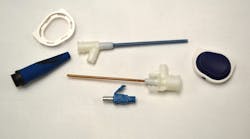
Contract manufacturers that perform precision micromachining play a useful role developing prototypes of biomedical parts smaller than 2 in3. Micromachining can replace or complement traditional EDM, forming, stamping, and injection molding for plastics, aluminum, brass, titanium, stainless steel, ceramics, and glass. For example, prototypes traditionally micro-injection-molded can be machined instead, thereby eliminating the need for expensive molds. Micromachining is also suitable for micro medical parts requiring intricate 3D freeform geometry.
Small machines for small partsSeveral manufacturing operations are available for the fabrication of micro parts, components with feature sizes less than 1 mm. Such operations include... Designers' Guide to Micromachining PlasticsThe pressure to reduce costs has many designers rethinking their material selections. Precision-flow devices, for instance, traditionally were constructed... Air-powered spindle gives micromachining a boostA recent spindle that runs on compressed air lets companies perform ultra high-speed and precision micromachining on existing machining centers. The RBX... Mechanical cochlea: One step closer to an artificial earEngineers at the University of Michigan have micromachined a life-sized cochlea that could one day translate acoustic vibrations into electrical signals... Pressure sensor eliminates common-mode errorsMillivolt Output pressure sensors reduce all output offset or common-mode errors. The sensors use a silicon, micromachined, stress-concentration-enhanced... Machining in MiniatureManufacturing tiny medical components can be tricky. Parts can have features that measure less than 100 micron about that of a human hair. At such fine... |
advertisement Webcasts
Latest in BlogsLeslie Gordon - "From Shop Floor to Software" |