Precision via piezo
Compactness, lower voltage requirements, higher torque, shorter response time, less heat, and nonmagnetic and vacuum compatible, are reasons why piezoelectric motors and actuators are found in an ever-widening range of medical devices and equipment.
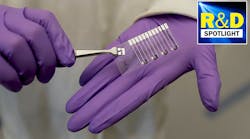
Miniature piezo linear motor
slide with on-board driver can
reach velocities of 200 mm/sec.
Select figure to enlarge.
Recent advances in piezoelectric motors and actuators are impacting medical applications. These include ultrasonic emitters, artificial fertilization, medical nano-microliter pumps, micromonitoring, surgery devices, MRI compatible robots, microdose dispensing, cell penetration and cell imaging in cytopathology, medical material handling such as pick-n-place systems, drug delivery devices, 3D scanning and for laser beam steering in ophthalmology, dermatology and cosmetology.
The piezo difference
A piezoelectric actuator (piezo actuator) is a type of solid state actuator based upon the change in shape of a piezoelectric material when an electric field is applied. It uses a piezoelectric ceramic element to produce mechanical energy in response to electrical signals, and conversely, is capable of producing electrical signals in response to mechanical stimulus.
Variety of piezo-ceramic motion control devices for use in bio-medical applications: XY microscope stage, miniature stage, RodDrive pusher and sub-miniature slides.
The use of piezoelectric materials dates back to 1881 when Pierre and Jacques Curie observed that quartz crystals generated an electric field when stressed along a primary axis. The term piezoelectric derives from the Greek word ‘piezein’, meaning to squeeze or press, relating to the electricity that results from pressure applied to a quartz crystal.
Piezoelectric ceramics consist of ferroelectric materials and quartz. High-purity PZT (plumbum, zirconate, titanate) powders are processed, pressed to shape, fired, electroded and polarized. Polarization is achieved using high electric fields to align material domains along a primary axis. Piezoelectric actuators in their basic form provide very small displacement, but can generate huge forces. The minute size of the displacement is the basis for the high precision motion they can deliver.
For long travel ranges, a clever arrangement of multiple actuators, or the operation of a single piezoelement at its resonance frequency have proven to be viable concepts. These types of piezo motion devices are called piezo motors.
The latest designs of piezo motors have advantages for use in medical equipment and devices. Two types of piezo motors, in particular, have considerable attributes for medical applications. They are: ultrasonic piezo linear motors (also called resonant motors), and piezo stepper motors. Both versions can provide virtually unlimited travel (movement), yet they are very different in their design, specifications, and performance.
PZT disk in Pari Pharma GmbH eFlow® Rapid Electronic Nebulizer. The atomizer head of the eFlow Rapid Electronic Nebulizer series employs an annular ultrasonic piezo transducer. (source: Pari Pharma GmbH)
In ultrasonic piezoelectric motors, the piezoelectric ceramic material produces highfrequency (inaudible to the human ear) acoustic vibrations on a nanometer scale to create a linear or rotary motion. For large travel ranges, especially when high speeds are also required, ultrasonic linear drives are used. With resolutions as good as 50 nm they become a better alternative to electromagnetic motor-spindle combinations. The ultrasonic drives are substantially smaller than conventional EM motors, and the drive train elements needed to convert rotary to linear motion are not required.
Ultrasonic piezoelectric linear motors employ a rectangular monolithic piezoceramic plate (the stator), segmented on one side by two electrodes. Depending on the desired direction of motion, one of the electrodes of the piezoceramic plate is excited to produce high-frequency eigenmode oscillations (one of the normal vibrational modes of an oscillating system) of tens to hundreds of kilohertz. An alumina friction tip (pusher) attached to the plate moves along an inclined linear path at the eigenmode frequency. Through its contact with the friction bar, it provides micro-impulses and drives the moving part of the mechanics (slider and turntable) forward or backwards. With each oscillatory cycle, the mechanics executes a step of a few nanometers. The macroscopic result is smooth motion with a virtually unlimited travel range.
Continue to next page.
Want to use this article? Click here for options!
© 2012 Penton Media Inc.
Acceptable Use Policy blog comments powered by Disqus
Webcasts
- How to Quantifiably Confirm Cure of Light Cure Adhesives
Sponsored by: Henkel - View Webcast Archive
advertisement