Many people think of Parkinson’s disease (PD) merely as uncontrolled shaking or tremors. Yet, virtually all people with PD’s suffer from a wide variety of afflictions and symptoms, including bradykinesia (slow body movements), dyskinesia (uncontrolled body movements, e.g. flailing), impaired speech, dizziness, loss of the sense of smell, urinary incontinence, constipation, and muscle stiffness. Many times shuffling replaces normal gait and posture becomes stooped-over. Add to this impaired sleep and depression; with the depression caused by the low dopamine levels, not by the cognitive awareness of the other symptoms. Eventually, most people with PD simply grind to a halt, unable to move. Swallowing becomes difficult, drastically increasing the incidence of aspiration pneumonia. Dr. James Parkinson, for whom the disease is named, called it “the saddest of diseases.”

Some of these symptoms mimic those of other diseases, for example multiple sclerosis (MS) and essential tremor. Essential tremor is a tremor in the arms, head or voice during voluntary movement. Currently, PD diagnosis is currently made through symptom observation. One carefully observed characteristic is the patients’ handwriting. When suffering from PD, a person’s handwriting becomes progressive smaller. The height of each letter diminishes until it dissolves into an illegible series of bumps or scribbles.

Another area of acute interest, with regard to PD diagnosis, is sleep abnormalities. A precursor to PD is REM sleep behavior disorder (RBD). One study showed that 38% of patients with RBD eventually developed PD. People with PD often experience vivid and detailed dreams, and it is not uncommon for them to attack their bed partners. By performing sleep studies, doctors are gaining insight into the RBD of Parkinson’s patients. About 38% of patients with RBD eventually develop PD.

Early PD diagnosis is important because there is evidence that progression might be slowed though not reversed.

Delivering and pedaling treatments

The causes of Parkinson’s are unknown (see sidebar), but in most cases Parkinson’s disease becomes apparent when the brains’ dopamine producing cells die off. Dopamine is a neurotransmitter that affects behavior, cognition, voluntary movement, motivation and reward, and sleep. Dopamine has another role too: as precursor to norepinephrine. Norepinephrine plays a dual role as both a drug and hormone affecting heart rate, glucose release, and blood pressure. PD symptoms are difficult to treat because dopamine can not cross the blood-brain barrier (BBB). The BBB also prevents dopamine from getting from cerebrospinal fluid into the blood stream, stymieing efforts to measure its concentration.

While the BBB is not a visible membrane it does separate circulatory blood and cerebrospinal fluid with a layer of epithelial cells, supported by astrocytes— a star-like cells. Small hydrophobic molecules pass it, as does glucose, which is actively transported across it, but hydrophilic molecules and most bacteria are stopped. Hence, though dopamine is readily synthesized, it is undeliverable in its present form, i.e., as a pure drug.

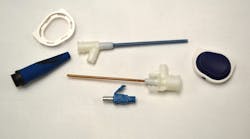
Until recently, natural diffusion was used to get the liposomes across the BBB. But researchers have developed a different method, called convection-enhanced delivery (CED). With CED a specially designed catheter is inserted into the brain. The catheters’ cannula design minimizes infusate reflux along the cannulas’ outer circumference by using steps. Reflux is the backflow of infusate up the cannulas’ outside rather into brain tissue. Metal cannulas have given way to ones made of silica.

The infusate is pumped into the spaces between the brain cells. Maximum infusion rate is about 5 µl/min; above this rate, reflux is again present. Distribution of the pressurized infusate is greatly enhanced by the body’s natural pulsation of blood vessels, resulting in an even concentration over a large area. Two methods are used to help ensure proper cannula placement. One is a guide glued to the skull with dental acrylic. The second is part of the CED infusate itself. The infusate contains Gadoteridol-loaded liposomes. Gadoteridol is an MRI contrast media. Cannula design and liposome delivery have profound implications not only for PD treatment but also for MS, Alzheimer’s, and various brain cancers.

Researchers are also investigating the development of a liposome that is essentially a doughnut-like structure loaded with dye, drugs, or nanoparticles. By various methods, this Trojan horse would pass through the BBB, and once inside, releases its payload. One way of getting the liposome past the BBB is known as carrier-mediated transport. The body actively pumps certain vital molecules past the BBB. By chemically linking the liposome to one of these molecules, the liposome is pulled past the barrier in a manner like a train engine pulls a boxcar.

While infusion pumps, cannulas, and Trojan horse delivery methods may offer long-term promise, researchers at the Cleveland Clinic are investigating a simpler therapy: exercise. They are studying how moderate and heavy exercise abates progression of the disease. Study participants are randomly divided into three groups: 1) no exercise; 2) moderate exercise; 3) heavy exercise. Each group completes the Unified Parkinson’s Disease Rate Scale (UPDRS)(a 176 point scale; the higher the number the more severe the disease), a series of instrumented dexterity tests, and a functional MRI. The dexterity test has six degrees of freedom (three axis) and the fMRI measures blood flow in various parts of the brain, for example the globus pallidus and basal ganglia, while subjects perform simple tasks, such as pushing a series of buttons or squeezing a ball. Together these establish a baseline.

The moderate and heavy exercise subjects ride an instrumented bicycle for an hour, three times a week. Then the tests are readministered. While the study is not complete, preliminary results seem to indicate both short-term and long-term improvements in the individuals that exercise. Two unexpected outcomes are the longevity of improvement; up to four weeks after exercise cessation and the improvement in the subjects’ mood. Exercising apparently gives people a sense of controlling their own destiny, a benefit not usually seen by people simply taking medication.

Electronic vs. medicinal

In addition to methods for delivering treatment and the potential for exercise regimes, there are PD therapies that break down into two camps: electronic and medicinal.

For 30 years drug therapy was the only FDA approved method for treating PD. Then, in 1997, Medtronic’s deep brain stimulator (DBS) gained FDA approval. DBS comprises three main components: an implantable pulse generator generally placed in the chest, the lead going into the brain, and the extension wire that connects the lead and pulse generator. Both the doctor and patient have external controllers that adjust the level of stimulation and turn the generator off and on. The electrodes are implanted in the basal ganglia. Pulse shape and frequency are non-invasively adjusted by a clinician who uses a hand held programmer with an LCD screen. Programmable parameters include frequency, amplitude, and pulse width. Communication between the devices is via radio telemetry.

To place the electrodes, an MRI or CT scan of the patients’ brain is used to map the brain. Then a frame or fiducial (a metal screw or marker secured to the skull as a reference point) is positioned and the electrode is inserted through a hole in the skull. The patient, who remains awake, is asked to perform a simple task, such as moving his fingers, which normally causes trembling or involuntary movement. The electrodes are then positioned for maximum affect.

In one study, DBS has been shown to maintain motor-symptom improvements after five years. And after following another group of DBS recipients for several years, researchers concluded that it is better to implement DBS sooner rather than latter. Interestingly, the reason DBS works is not well understood; many researchers are trying to figure out why it does. One theory is that it mimics pallidotomy– surgical destruction of specific cells in the brains globus pallidus. But unlike pallidotomy, DBS is reversible, and benefits are adjustable. Also unlike pallidotomy, DBS can be either bilateral or unilateral depending on the extent of tremor. Pallidotomy can not be done bilaterally without the risk of serious side effects, such as loss of speech.

Two models of stimulators are available, the Activa RC and the Activa PC. The RC is rechargeable and has a nine-year life. A wireless recharger replenishes the batteries. Patients can move about while recharging, which takes about two hours every two weeks. The PC provides continuous stimulation for multiple years. The Activa DBS has been shown to increase periods of good mobility (defined as no symptoms or involuntary excessive movements) from 27% to 74% of a patient’s waking day.

DBS has been found to be effective for diseases other than PD. It also helps in patients with essential tremor, dystonia, and obsessive compulsive disorder too. Like PD, essential tremor causes rhythmic shaking in the limbs, head, or voice. Dystonia is characterized by involuntary muscle contractions, resulting in contorted movements or postures.

When it comes to medicinal therapies, the drug levodopa, first used in 1967, remains the primary drug of choice to combat symptoms, although today it is combined with other drugs to prevent uptake by the peripheral nervous system (the brain is part of the central nervous system) and slow its metabolic breakdown. Even so, in it most common form a mix of levodopa and carbidopa, it has a short half life- about one and a half hours. By itself, levodopa’s half life is only 45 minutes.

Doctors sometimes prescribe levodopa/carbidopa to aid in PD diagnosis. If the patient takes the drug and symptoms diminish, the diagnosis is PD. If not, it’s something else.

Since the advent of levodopa six drug classes have been developed to treat PD.

Dopaminergic drugs like levodopa mimic dopamine. Decarboxylase inhibitors such as carbidopa slow the breakdown of dopamine-like drugs. Dopamine agonists, for example mirapex, bind to dopamine receptors and imitate dopamine. Some clinicians argue that levodopa poses toxicity problems because its oxidative mechanism leads to increased generation of hydrogen peroxide. This in turn leads to more brain damage. They support use of dopamine agonists as an alternative.

Anticholinergics, e.g. benztropine, block the neurotransmitter acetylcholine and relax smooth muscle such as the bicep or triceps.

MAO inhibitors block a metabolic pathway that stops activity of monoamine oxidase. There are two types: MAO-A and MAO-B; dopamine is broken down by both. A drug that blocks MAO-B breakdown is azilect. Azilect may be the most important drug developed since levodopa because there is empirical evidence that it slows, if not reverses, PD. In an 18-month long, double blind study of 1,176 subjects, azilect, in 1 mg daily doses, was shown to slow the progression of PD. The study, called ADAGIO (Attenuation of Disease Progression with Azilect Given Once-daily) had an interesting result: daily 2 mg doses were less effective than the 1 mg doses. The different outcomes corresponding to the two different doses have yet to be explained, and some argue the improvement at a lower dosage is a false-positive result.

Azilect represents a breakthrough in another important way. Usually MAO inhibitors require strict drug and dietary restrictions. For example, cold remedies or foods such as soy bean products, air dried meats, and aged cheeses have to be avoided because they contain tyramine, an amino acid. Tyramine, when ingested by a person on an MAO inhibitor can cause a dangerous increase in blood pressure because it is not broken down. But azilect, in 1 mg or 0.5 mg doses, has been found to be selective in its action and does not stop tyramine breakdown, and thus is not subject to dietary restrictions.

Another metabolic pathway is called the COMT. The drug entacapone works to block this and is often combined with carbidopa and levodopa in a drug called stalevo. Often, two or three drugs are administered at the same time.

There are several disadvantages to drug therapy. One is that over time it generally becomes less effective. Essentially, the body builds up a tolerance for levodopa. A second problem is the cost. Medication typically costs $2,500 to almost $6,000 per year. While insurance sometimes reduces out of pocket expenses, overall cost remains high.

Regardless of their specific roles, i.e. delivering a signal or controlling a pump, electronic devices will play a critical role in the treatment of people with Parkinson’s disease.


The enigma of Parkinson’s


Despite almost 200 years of study, and 60,000 new patients a year, Parkinson’s Disease (PD) remains one of the most difficult diseases to diagnose and treat. It is difficult to diagnose because there are no readily measurable biomarkers: nothing to be measured in a patient’s blood or serum, and nothing readily visible in MRI scans or radiographs. Currently, available treatments only diminish symptoms. There is no cure for the disease itself and little evidence of one being on the horizon.

PD becomes apparent when 50 to 80% of the brains’ dopamine producing cells die off. Dopamine production occurs in several different brain structures, most notably in the substantia nigra, medulla, and the ventral tegmental area. The cause of the cell die-off remains a mystery, but there is a considerable amount of evidence pointing to a cellular inclusion called Lewy bodies. Lewy bodies are also present in Alzheimer’s and other central nervous system disorders. Why Lewy bodies develop is anyone’s guess. Three factors may be at work: genetics, environmental, and physical trauma. The general consensus is that genetics predispose a person to the condition, and the environment or trauma activates it.

However, questions remain even with this hypothesis. For example: What caused people to contract the disease 200 years ago, when modern day environmental stimuli were non-existent?

For more on PD . . .


A number of organizations are available to provide help both for people with PD and for researchers. These include the Parkinson’s Disease Foundation (pdf.org) and the Davis Phinney Foundation (davisphinneyfoundation.org). Both of these organizations provide guidance and help for people with PD, as well as funding for PD research. PDF also leads PDtrials (pdtrials.org), a collaborative initiative of Parkinson’s organizations dedicated to increasing education and awareness about clinical research. Central to this effort is providing information to help people with Parkinson’s learn more and make informed decisions about participating in clinical studies. PD Trials offers a forum for phase1, phase 2 and phase 3 studies.